
Black Friday Is for Shopping. Your Year-End Estate Planning Checklist Is for Everything Money Can't Buy.
By Kristen Mackintosh, The Happy Lawyer NC
It's Black Friday! The sales are calling. The shopping carts are filling up. And somewhere, someone is convincing themselves they absolutely need a third air fryer because it's 40% off.
Maybe you've been up since 5 a.m. hunting for bargains. Maybe you're shopping from the comfort of your couch, wearing your favorite pajamas and sipping coffee. Or maybe you're avoiding the whole thing because you've decided that no discount is worth fighting someone over the last television.
Whatever your Black Friday strategy, there's something about this time of year that makes us think about our lists. Shopping lists. Christmas lists. Grocery lists. Lists of people we still need to buy presents for. Lists of things we forgot to buy when we were at the store yesterday.
But there's one list that probably isn't getting nearly enough attention. Your year-end estate planning checklist.
I know, I know. Estate planning doesn't exactly sound as exciting as a 70% off sale. But stick with me.
Because while Black Friday is all about buying things, estate planning is about protecting the things money can't buy. Your family's peace of mind. Their security. Their ability to make decisions during difficult times. And perhaps most importantly, the gift of not leaving them with a giant mess to sort out someday.
And unlike that fancy new coffee maker, a thoughtful estate plan can make a difference for generations. So before we turn the calendar to 2027, let's check ten important things off a different kind of shopping list.

1. Check Your Will or Trust: Is It Still on Your Wish List?
Have you ever found something in the back of your closet and wondered, "What on earth was I thinking when I bought this?" Sometimes estate planning documents can feel the same way.
Maybe you signed your will fifteen years ago, when your children were little. Now they're grown, married, and raising children of their own.
Maybe the person you named as executor has moved across the country. Or perhaps someone you originally wanted to inherit your property is no longer part of your life.
Life changes. Families change. Relationships change. Your estate plan should keep up with those changes.
In North Carolina, a properly executed will generally doesn't expire just because it's old. But that doesn't mean it still reflects your wishes or works well for your family.
Your year-end checklist: Find your will or trust and review the names, gifts, and instructions. If something no longer feels right, make a note to discuss it with your estate planning attorney.
And please don't write changes in the margins or cross out provisions yourself. Changes need to be made using legally appropriate documents and procedures.
2. Review Your Decision-Makers: Are the Right People Still in Your Cart?
When you created your estate plan, you probably chose people to serve in important roles. Your executor. Your trustee. Your financial agent. Your health care agent. Maybe even guardians for your minor children. But are those people still the best choices?
Your brother might have been the perfect executor ten years ago. Today, he may be dealing with health problems of his own.
Your daughter might have been living nearby when you named her as your health care agent. Now she lives three states away.
And that cousin who seemed so responsible years ago? Well, let's just say you wouldn't necessarily trust him to water your houseplants.
Choosing someone to make financial, medical, or estate decisions is a big responsibility. The right person isn't always the oldest child or the family member who lives closest. It's someone who is trustworthy, capable, willing, and able to handle the role.
Your year-end checklist: Review every person named in your documents, including backups. Make sure they're still appropriate choices and willing to serve.
Because the last thing your family needs during an emergency is to discover that your first choice can't serve and you never named a second.
3. Check Your Powers of Attorney: Because Life Doesn't Always Offer Free Returns
Imagine you're in the hospital and unable to make financial decisions. Who can pay your bills? Talk with your bank? Handle insurance matters? Manage your financial affairs?
Now imagine an important medical decision needs to be made, but you can't communicate your wishes. Who speaks for you? These aren't pleasant scenarios to imagine, but they're important ones to prepare for.
A durable financial power of attorney allows someone you choose to handle authorized financial matters for you. A health care power of attorney allows your chosen agent to make health care decisions under the circumstances provided in the document and North Carolina law.
You may also want a living will, sometimes called an advance directive for a natural death, to communicate your wishes about certain end-of-life medical decisions.
These documents are especially important because a will generally doesn't help your family manage your affairs while you're alive.
Your year-end checklist: Confirm that your financial and health care documents are current, properly executed, and accessible when needed.
Remember, being married doesn't automatically give your spouse unrestricted authority to handle every financial transaction on your behalf.
And your adult children don't automatically receive blanket authority to make all your decisions, either.
4. Check Your Beneficiaries: The Fine Print Matters More Than the Sale Price
Here's something that surprises many families. Your will doesn't necessarily control who receives everything you own. Life insurance policies, retirement accounts, and certain bank or investment accounts may pass directly to the people named on beneficiary designations. That means an outdated beneficiary form can create a very expensive surprise.
Imagine carefully updating your will after a divorce, only to discover that an old life insurance beneficiary designation was never changed. Or perhaps you named one child on an account years ago, intending that child to divide the money among all the siblings. That arrangement may not work the way you expect.
Beneficiary designations deserve just as much attention as your will or trust.
Your year-end checklist: Review the primary and contingent beneficiaries on retirement accounts, life insurance, and accounts with payable-on-death or transfer-on-death designations.
Make sure they coordinate with your overall estate plan.
And don't assume that naming a minor child, a person receiving needs-based benefits, or your trust as a beneficiary is always the best choice. Those decisions can have important legal and tax consequences.
5. Make Sure Your Trust Is Funded: An Empty Shopping Cart Doesn't Deliver Much

Let's talk about one of my favorite estate planning reminders. Creating a revocable living trust is an important step. But signing the trust document is not necessarily the finish line.
Think of it this way. You can spend hours filling an online shopping cart with everything you want. But if you never complete the checkout process, those items aren't coming to your house.
A trust can have a similar problem. If assets that should be owned by your trust were never properly transferred, your trust may not accomplish everything you intended.
For example, if your home is supposed to be owned by your trust, you generally need an appropriate deed transferring ownership. Other assets may require account retitling or carefully coordinated beneficiary designations.
Not every asset should necessarily be retitled to your trust. Retirement accounts, for example, require special consideration.
Your year-end checklist: If you have a trust, review your funding instructions and confirm that your assets are titled or designated appropriately.
A trust that isn't properly funded can leave your family facing probate or other complications you were trying to avoid.
And nobody wants to discover that after the fact.
6. Update Your Plan After Major Life Changes: Some Things Aren't One-Size-Fits-All
One of the best things about the holidays is catching up with family. We hear about new babies, engagements, weddings, graduations, retirements, and exciting new adventures. But not every change is happy.
Families also experience divorces, deaths, serious illnesses, estrangements, and unexpected financial challenges. Any of these changes may affect your estate plan.
Perhaps you welcomed a new grandchild this year. Maybe one of your children got married, and you're wondering how to protect an inheritance. Maybe your spouse died, or you've recently remarried and now have a blended family. Or perhaps you've purchased a second home, sold a business, or inherited property.
Your estate plan should reflect your life as it exists today, not just the life you had when you originally signed the documents.
Your year-end checklist: Think back over 2026. Did anything significant happen in your family, finances, health, or relationships?
If so, consider whether your estate planning documents need another look.
And remember that North Carolina law can affect certain provisions after events such as divorce. Don't assume the law automatically makes every change you would want.
7. Talk With Your Aging Parents: The Conversation That Won't Fit in a Gift Bag

Thanksgiving brings families together. There's turkey, stuffing, pumpkin pie, and at least one family member who insists that their recipe is the only correct way to make sweet potato casserole.
But holiday visits can also reveal things we don't notice during quick phone calls. Maybe Mom seems more forgetful. Maybe Dad is having trouble keeping up with bills. Maybe the house isn't as well maintained as it used to be. Or perhaps your parents are doing wonderfully, but you've realized you have no idea where their important documents are or whom they've chosen to make decisions if something happens.
These conversations can feel awkward. Nobody wants to interrupt dessert by announcing, "So, Mom, let's discuss your estate plan!" Fortunately, you don't have to.
Start gently. Ask whether they have the documents they need. Find out where important papers are kept. Make sure they know you're willing to help if they ever need it.
The goal isn't to take control of your parents' decisions. It's to help them maintain independence and make their wishes known while they can.
Your year-end checklist: Have one thoughtful conversation with an aging parent or loved one about their plans, preferences, or important documents.
You don't need to solve everything in one sitting.
Sometimes simply starting the conversation is the most valuable gift you can give.
8. Organize Your Important Information: Don't Leave Your Family a Scavenger Hunt
Picture this. Your family needs to locate your estate planning documents. They check the filing cabinet. Nothing. They search the desk drawers. Still nothing.
Someone remembers you mentioned a safe deposit box, but nobody knows where it is. Then someone discovers a folder labeled "IMPORTANT PAPERS," which contains three expired warranties, an instruction manual for a microwave you no longer own, and a coupon from 2017.
Sound familiar? Even the best estate plan can be difficult to carry out if nobody knows where to find the information.
Your family may need access to contact information for your attorney, financial advisor, accountant, and insurance agent. They may also need to locate important account information, deeds, insurance policies, and instructions about digital assets.
You don't need to give everyone immediate access to your private financial information. But you should have a secure system that allows the appropriate people to find what they need when the time comes.
Your year-end checklist: Create or update an organized inventory of important documents, accounts, and professional contacts.
Tell the appropriate person where the information is stored and how it can be accessed when legally authorized.
And while you're at it, maybe retire that microwave manual.
9. Think About Long-Term Care: Because Medicare Isn't an Unlimited Gift Card
Here's something I wish more families understood. Medicare generally does not pay for ongoing custodial long-term care simply because someone needs help with everyday activities. That's a surprise many families discover only when a parent needs assisted living, memory care, or nursing home care. And by then, decisions may need to be made quickly.
Long-term care planning isn't just about nursing homes. It's about maintaining choices.
Where would you prefer to receive care? Who would help you make decisions? How might care be paid for? What financial resources would be available to a spouse who remains at home?
For some families, Medicaid planning may be appropriate. For others, the discussion may involve savings, insurance, family support, or other arrangements.
North Carolina Medicaid eligibility rules are complex, and transfers of assets can have significant consequences.
Your year-end checklist: Consider whether you or your aging parents have a realistic plan for future care needs.
If protecting assets or qualifying for Medicaid may be part of that plan, seek individualized advice before transferring property or making major financial changes.
The earlier you understand your options, the more opportunities you may have to make thoughtful decisions.
10. Give Your Family the Gift of Peace of Mind: No Wrapping Required

We've reached the last item on our checklist. And this one might be the most important.
You don't have to finish every estate planning task before December 31. There isn't a universal North Carolina rule requiring everyone to update their estate plan by the end of the year. But the end of the year is a wonderful opportunity to stop putting important things off.
Maybe you've been meaning to create your first will. Maybe you have a trust that needs attention. Maybe your powers of attorney are outdated. Or maybe you've been thinking about talking with your parents but haven't found the right moment.
Choose one thing. Schedule the appointment. Find the documents. Review the beneficiary forms. Start the conversation. You don't need to tackle everything at once.
Your year-end checklist: Identify your top estate planning priority and take one meaningful step toward completing it.
Because the most important part of estate planning isn't the paperwork.
It's the people.
The Best Gifts Don't Always Come in Boxes
By the time Black Friday is over, we'll have purchased plenty of things. Some will be wonderful gifts. Some will be practical purchases. And some may eventually find their way into the closet beside that exercise equipment we were absolutely going to use.
But the gifts that matter most aren't always the ones we wrap. They're the gifts of knowing someone will be there to make decisions when we can't.
Knowing our children will be cared for. Knowing our wishes are understood. Knowing we've done what we can to spare our loved ones unnecessary confusion, conflict, and stress.
As an estate planning and elder law attorney, I've seen how meaningful those gifts can be to families. And that's why I believe estate planning is ultimately an act of love.
It's not about dwelling on what might go wrong. It's about taking care of the people who matter most, whatever the future brings.
So enjoy your Black Friday shopping. Find those bargains. Buy the gifts. Treat yourself to that new coffee maker if you really want it.
But before you turn the calendar to 2027, take a little time for another kind of list. Because Black Friday deals expire. A thoughtful estate plan can leave a legacy that lasts for generations.
Ready to Check Estate Planning Off Your Year-End List?
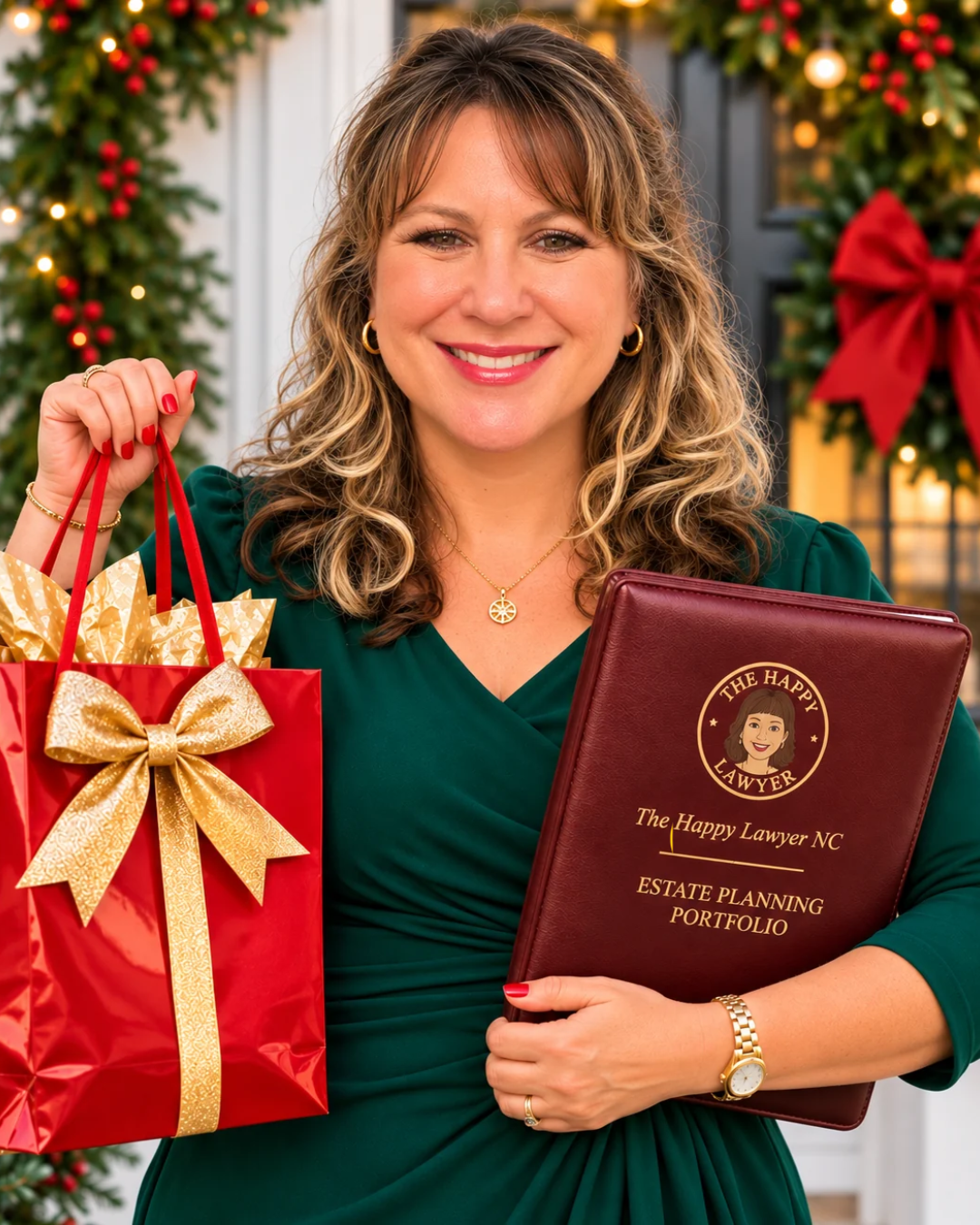
At The Happy Lawyer NC, we help individuals and families throughout Garner, Raleigh, Wake County, Johnston County, and across North Carolina create estate plans that reflect their wishes and protect the people they love.
Whether you need to create a new estate plan, review existing documents, discuss long-term care planning, or make sure your trust is properly funded, we're here to help you understand your options. Learn more about our services.
We offer free Discovery Calls to learn more about you and how we might be able to help. You can contact us at (919) 336-4219 to schedule your free Discovery Call. Or, you can schedule your call using the button below:
Legal Disclaimer: This article provides general educational information about North Carolina estate planning and elder law. It is not legal advice and does not create an attorney-client relationship. Every family's circumstances are different. Consult a qualified North Carolina attorney before making estate planning decisions or transferring assets.